Grassroots organizing—bringing advocates together to take action for a cause—is hard. Grassroots environmental organizing is even harder. Still, history has shown that uniting a critical mass of individuals to speak with one voice has the power to influence society or even radically change the world.
One of the biggest obstacles standing in the way of successful movements is that there’s no agreed-upon guidebook for organizers. Anyone who wants to launch a campaign tends to do their own thing in their own way, often with no knowledge of what’s worked in the past or what hasn’t, no clear guidelines for how to move forward, and no benchmarks for measuring success or failure. This tends to make things frustrating or even exhausting for organizers and unsatisfying or pointless for advocates.
But what if we could come up with a blueprint for how organizers and advocates might work together to build a powerful environmental campaign?
Unfortunately, it’s impossible, so don’t even bother trying…Kidding! Just so happens that Eco-Integrity Alliance, through decades of research and experience, trial and error, wins and losses, has come up with one. And we’re about to share it with you in hopes that the valiant grassroots environmental movement can finally start slowing, and then reversing, the eco crisis.
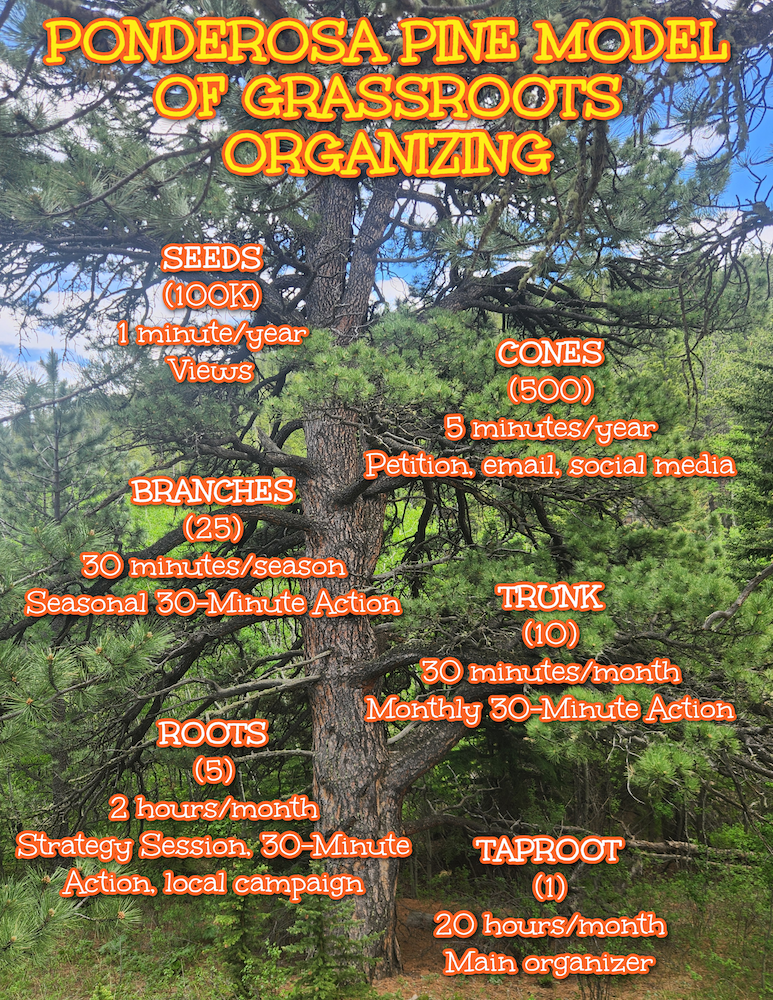
THE PONDEROSA PINE MODEL OF GRASSROOTS ORGANIZING
While we’re proposing a complete model, organizers are free to pick bits and pieces they find useful to see what works for them. In fact, such alterations might even be improvements on the original, which we see as a fluid structure. (But if you don’t follow the model and keep losing, don’t come crying to us!)
If we enviros know anything, it’s that nature has wisdom that we must pay attention to if we’re going to survive and thrive. And what more perfect creation is there than a tree? So, we decided to base the model off that miraculous organism that gifts the planet air, water, soil, climate, habitat, food, and life itself.
Which is why Eco-Integrity Alliance has named it the Ponderosa Pine Model of Grassroots Organizing.
Why not just call it the Tree Model and be done with it? Isn’t ponderosa pine (Pinus ponderosa) only one of many species endemic to the dry forests of the western U.S.?
There’s a reason why we chose this particular tree, although others such as oak, walnut, hickory, beech, sycamore, gum, butternut, and hornbeam would do just as nicely. That reason? Ponderosa pines (and these other species) have a taproot that it sinks deep into the soil to anchor the entire tree.
As with a tree, there are different parts, all of which are essential. In the case of the Ponderosa Pine Model, people can find the role that best suits them. This way organizers know what to expect of advocates, who to ask for help and who to not. And advocates can tap in at their desired level of commitment, which might change over time. With all of this in place, everyone doesn’t just feel like but becomes part of a functioning whole.
TAPROOT
In the Ponderosa Pine Model, the Taproot is the main organizer. While many of us might be egalitarian, anti-authoritarian, or even anarchist, the reality of a campaign is that someone’s gotta be in charge of getting the ball rolling and keep it moving. While it doesn’t have to be one person, for whatever reason—natural, societal, combination of the two—it almost always is. And, as with a lot in nature, enviros sometimes need to know how to swim with the current rather than resist it.
So, the Taproot is the person holding down the bottom line.
While the Ponderosa Pine Model can work for national or local campaigns, in this article we’ll be using it for statewide campaigns. What that means is the Taproot is the State Advocate for whom we suggest a time commitment of 20 hours per month or five hours per week.
That means the role can be held by a paid staffer for an organization or a volunteer with five weekly extra hours on their hands. So, if you have a knack for or enjoy facilitating (more a secretary than a boss) and you’ve got that free time, this is the job for you (if not, it’s best to find someone else before launching your campaign, because without a strong taproot, the whole tree falls down).
Now that we’ve got the hours down, what tasks is the Taproot responsible for?
Campaign Organizing
The main duty of the Taproot is organizing the state campaign. This requires acting as manager of the team, aware of all the roles on the field—not necessarily playing them yourself but capable enough in each of them in case anyone needs guidance or assistance.
Strategy Sessions
The Taproot’s second job is making sure everyone’s getting together on a regular basis for what we like to call Strategy Sessions. If people live in the same area these can be in-person, otherwise online video calls work best. While a particularly urgent campaign might require bi-weekly or even weekly meetings, the best way to keep people engaged without burnout is once per month, ideally the same day and same time (i.e., first Sundays at 5 p.m.). The Taproot is in charge of scheduling each meeting, procuring a video chat account, and sending out monthly reminders at least a day in advance (ideally also day of).
Strategy Sessions can involve people getting to know each other (brief intros whenever a new person arrives), ideally with a pre-decided agenda which should include local/county updates, especially for Roots (more on them later). The Taproot’s charge is to facilitate meetings so they move along with everyone getting a chance to speak, keep to the agenda, ensure the group votes on the most important piece—the monthly 30-Minute Action—and take notes to send out afterward. Ideally, Strategy Sessions wouldn’t go longer than an hour (in-person ones can be extended since there’s usually more socializing).
30-Minute Action
The 30-Minute Action is the heart of the campaign, a way to get folks on the same page while covering the whole gamut of tactics. It matters less what you do so long as it happens every month and gets as many people as possible to do it.
Examples of 30-Minute Actions broken down into four categories (you can expand or shrink these if you want):
-Media (Contact reporters; write and submit letter to the editor/opinion).
-Government (Attend Commissioners/Council/agency virtual or in-person meeting; virtual meeting with elected official; call/email comments; sign and share petition).
-Outreach/Education (Event tabling; group hike; rally; public forum; flyers).
-Social Media/Website/Blog (Write post/make video; comment/like/share post on social media; paid ads to target location/demographics).
Government/Elected Officials
The Taproot will often, if not always, be the point person for engaging with elected officials and their staffers as well as government agencies. This means polite, professional, but honest and up-front communications and follow-up if and when there is no response.
Public Outreach
The Taproot will usually—but doesn’t have to—take the lead in getting word out to the public to recruit more advocates or community support. This can be done online or in person through a wide variety of methods and means, some of which are mentioned above.
Media
Unless someone else on the team is willing, The Taproot might need to bottom-line crafting press releases and contacting media, as well as writing or soliciting opinion pieces/letters to the editor. This sometimes involve developing personal relationships with reporters and/or civilly holding them publicly accountable for biased, poor, or absent coverage.
Website/Blog/Social Media
The Taproot—and ideally other advocates—should regularly post on social media, whether short, engaging messages, articles written or curated from others or elsewhere, as well as videos, images, memes, and cartoons.
Communications
The most important, time consuming, and least glamorous role of the Taproot is communications. This will typically be via email and phone and include prompting and reminders. The truth is, much of the Taproot’s communications work is keeping track of emails you sent out that didn’t get a response and then politely following up again. The hardest part is deciding whether or not to keep touching base or accept that someone has fallen off the radar and isn’t worth contacting anymore. This can include elected officials, media, or advocates.
ROOTS
While a tree can’t last very long without a Taproot, it can’t stand at all without the other roots. These can be called Lateral Roots or just Roots, and they make the difference between a lone advocate precariously teetering by themselves and a sturdy campaign.
If this is a statewide effort, your Roots will be representatives of a County. To the outside public, you can label them as your County Advocates.
For whatever reason, at least five seems to be the magic number for Roots, though the more the merrier. That means finding five people, one per county, which gives your campaign a breadth of representation and legitimacy. It’s okay to have more than County Advocate for the same area, but that wouldn’t count towards your five.
A Root’s time allotment need not be more than two hours per month, and that includes one hour to attend monthly Strategy Sessions. The other hour can be split between the monthly 30-Minute Action and other local efforts for their county (obviously Roots can do more, but if all Roots took two hours every week, you’d be well on your way to winning).
TRUNK
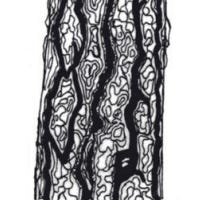
Roots are essential for keeping a tree standing upright. But the trunk is the main structure of a tree.
In the Ponderosa Pine Model, Trunks are those who can be counted on to take on the campaign’s central task, the 30-Minute Action. Members of the Trunk are asked to try to complete that action every month, whenever possible (it’s fine to miss some months, though hopefully the majority of the year is covered). For these actions to really resonate, the ideal number of Trunk members are at least ten. Less is of course okay, but the Taproot and Roots might want to keep searching for folks to make up the Trunk until that threshold is met.
BRANCHES
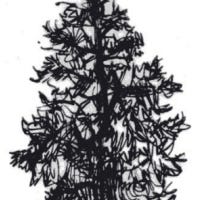
Nature has its seasons, and so does advocacy. There’s a role for those who want to be an important part of the tree but have only so much time to give. Branches are those who take the 30-Minute Action every three months or seasonally.
While each tree branch may not be as essential as its roots or trunk, a tree still requires them—and its leaves or needles that catch the sunlight—to grow. And many at that, so the number to shoot for here is at least twenty-five Branches.
CONES

Cones may not be relevant to the lifespan of any specific tree, yet they ensure that the surrounding forest will continue to prosper.
For the Ponderosa Pine Model, Cones are those who take a very brief, small action that can empower the rest of the campaign. This can come in the form of signing petitions, subscribing to email lists, or sharing, commenting, and liking posts on social media, or having conversations.
These seemingly minor contributions are bolstered by sheer numbers, with the goal being at least five-hundred Cones for any given campaign. For instance, that many signatures on a petition gives Roots, Branches, and Trunks the social proof they need to get the attention of elected officials, media, or the general public.
SEEDS

In nature, what may seem small may actually be hugely important. As with a forest, there can be no future without planting seeds.
For the Ponderosa Pine Model, Seeds are those who might view campaign blogs, social media posts, media articles, or even just flyers or banners. An estimate of a hundred thousand per year might seem like a lofty goal, but it’s quite doable if the rest of the tree is standing strong.
Seeds may not play much of a role now, but with the right combinations of fertile soil, rainfall, and sunlight, they will grow into the future forest. Without them, the forest will someday die.
CONCLUSION
The Ponderosa Pine Model of Grassroots Organizing is of course only one way to organize campaigns. It can be taken whole, piecemeal, or even evolved by those who wish to use it.
Eco-Integrity Alliance designed it to be helpful to our campaigns and ideally others taking on ecosystem, wildlands, wildlife or any other form of environmental advocacy. It can also of course be used for non-environmental campaigns.
A model is a path towards victory. But there are two things that matter even more for a winning campaign.
The first is the Vision or final destination you hope to reach, even if not in our lifetime. And the second is the Mission or steps you must take along the path to get there.
Combined with a powerful vision and solid mission, the Ponderosa Pine Model of Grassroots Organizing is the way to win!
Ponderosa Pine Model of Grassroots Organizing (Summary)
TAPROOT (Main Organizer)
People: 1
Time: 20 hours/month
Tasks: Campaign organizing; facilitate monthly virtual strategy sessions; monthly 30-Minute Action; interface with government; public outreach; media; website/blog/social media; communications.
ROOTS (County Advocates)
People: 5+
Time: 2 hours/month
Tasks: Monthly Strategy Session; monthly 30-Minute Action; 30 minutes for local campaign.
TRUNK (Monthly Advocates)
People: 10+
Time: 30 minutes/month
Tasks: Monthly 30-Minute Action.
BRANCHES (Seasonal Advocates)
People: 25+
Time: 30 minutes/season
Tasks: Seasonal 30-Minute Action.
CONES (Yearly Advocates)
People: 500+
Time: 5 minutes/year
Tasks: Sign online petition; subscribe to email list; engage on social media; in-person conversation.
SEEDS (Future Advocates)
People: 100,000
Time: 1 minute/year
Views on blogs, social media accounts, media.

