Comments Needed on U.S. Forest Service’s “Post-Fire Recovery: by Monday, Jan. 26

-By Rocky Smith, Forest Management Consultant (Denver, Colorado) & Eco-Integrity Alliance
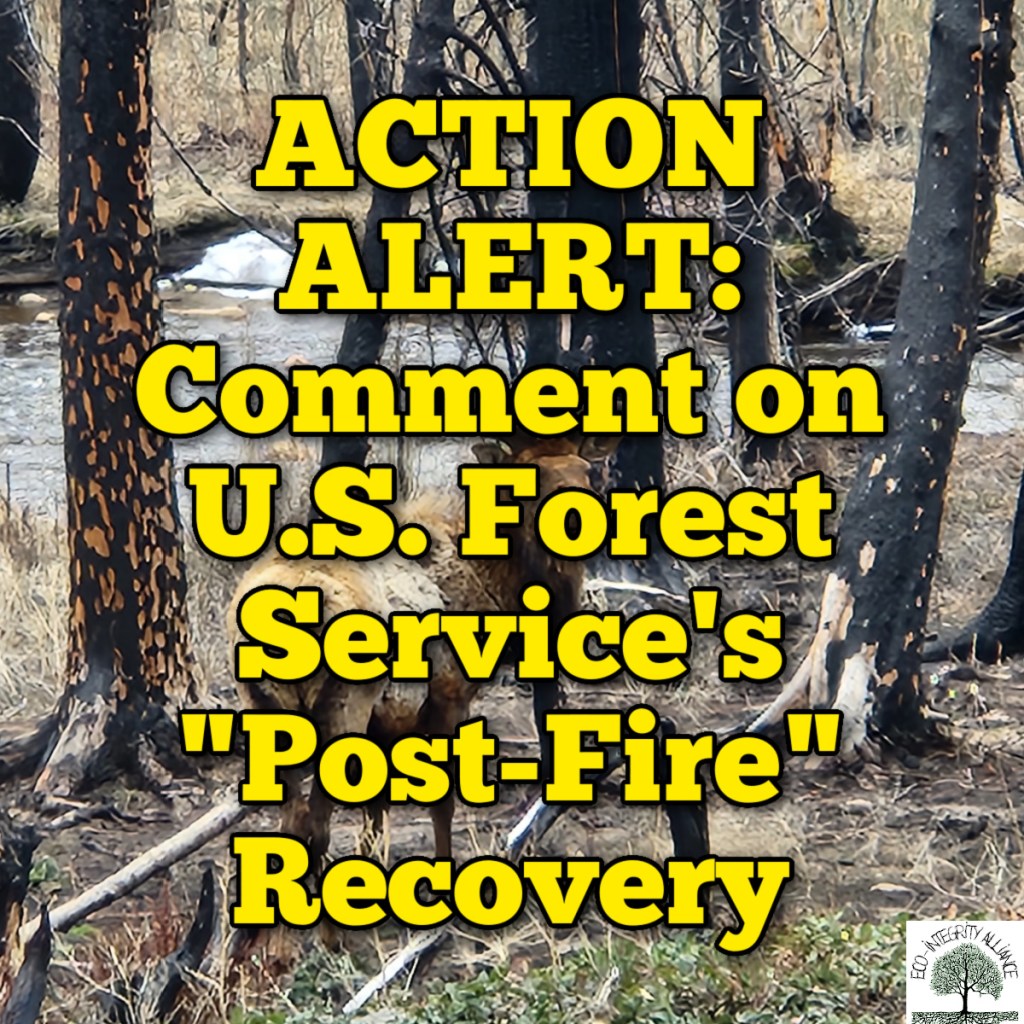
The U.S. Forest Service is proposing a nationwide Environmental Assessment (EA) “to analyze the effects of post-fire recovery actions”—i.e. destructive logging and roadbuilding—in National Forests.

Specifically, the agency wants to log “fire-killed and damaged trees before they lose their economic value” (including clearcutting and old-growth trees) and rebuild permanent roads or build new temporary roads as needed to do so.

The federal effort appears designed to lock in the idea of doing actions—especially “salvaging” fire-damaged trees—on lands affected by fire, potentially in essential wildlife habitat and  important forest ecosystems, and to encourage large-scale actions, including those that occur on more than one Ranger District or even National Forest/Grassland. Given potentially low budgets and lack of personnel, the danger is that the agency will use the national EA as an excuse for doing minimal or no NEPA (National Environmental Policy Act) analysis for projects.

Some post-fire actions may be justified, such as: emergency erosion control, legitimate actions to maintain public safety, and responding to early stages of invasive species. However, the scientific literature is clear that burned forests are vital living ecosystems, and that any logging, roadbuilding, and/or use of heavy equipment accelerates soil erosion and slows or even prevents natural tree regeneration.

TALKING POINTS FOR COMMENTS (feel free to use any or all of these):

 -Areas that have recently experienced wildfire vary greatly across the National Forest system making a one-size-fits-all analysis impossible. If a nationwide analysis occurs, it should be a more in-depth Environmental Impact Statement (EIS), not just a simplified Environmental Assessment (EA). The public should be allowed to comment on the draft document.

-Post-fire logging and road construction is an ecological disaster, as burned forests—even severely burned—are crucial components of forest ecosystems and necessary habitat for an abundance of wildlife species (some of which require burned forests for survival). Post-fire logging destroys forest ecosystems and wildlife habitat, and the use of heavy equipment disturbs fragile soils recovering from fire. This slows recovery of vegetation, including reforestation.

-If projects are approved, there must be money and qualified personnel available to monitor and evaluate impacts.

Comments are due on Monday, January 26. Please submit them through the Federal eRulemaking Portal: https://www.regulations.gov/document/FS-2025-0034-0001
Green Root Podcast #108: Democrats Greenwashing Trump’s Assault on Public Land?

On episode 108 of the Green Root Podcast (the official podcast of Eco-Integrity Alliance), host Josh Schlossberg tries to figure out why so many supposedly pro-environment Democrats not only refuse to fight Trump’s onslaught on public lands but ACTIVELY PROMOTE the unprecedented extraction.

Josh talks about:

-The danger of Democrats greenwashing some of the most disastrous anti-environmental policies we’ve ever seen.

-How Biden-era legislation opened the door for Trump to expand a fake “emergency” across 112 million acres—59 percent of National Forests—to fast-track Wildfire Pretense Logging and roll back the Roadless Rule.

-How Democrat members of Congress are pushing the Orwellian “Fix Our Forests” Act and other extreme nature-destruction bills.

-How a handful of corporate foundation-funded “conservation” groups are trying to commandeer more tax dollars for Democrat-backed industrial extraction on public lands.

-Whether the Democratic party can be reformed or if a third party is needed for our government to ever genuinely protect and preserve the natural world.

Green Root Podcast #107: DO COWS BELONG ON PUBLIC LAND? (with Dagny Signorelli, Western Watersheds Project)

On episode 107 of the Green Root Podcast (the official podcast of Eco-Integrity Alliance), Dagny Signorelli, Wyoming/Northern Utah Director with Western Watersheds Project, exposes the severe and worsening ecological, wildlife, and watershed impacts from ranchers grazing livestock on public lands across the West.

Host Josh Schlossberg talks with Dagny about:

-How supposedly protected public lands—including wilderness areas—run rampant with destructive domestic livestock (cattle and sheep).

-How ranchers only pay a monthly fee of $1.35 per cow and calf to graze on National Forests and BLM lands.

-How government “Wildlife Services” kills hundreds of thousands of wolves, coyotes, bears, mountain lions, bobcats, foxes, skunks, and other native wildlife every year at the behest of ranchers.

-How public lands grazing and feedlots spread disease.

-How less than 1.6% of U.S. beef consumption comes from public lands.

-Dagny’s take on a root cause of the ecological crisis.

Conservationist Files Lawsuit Against Jefferson County Commissioner Lesley Dahlkemper for Alleged Violation of Colorado Open Records Act

Ecosystem advocate, Josh Schlossberg, filed a civil complaint in District Court in Jefferson County, Colorado last week alleging that Jefferson County Commissioner Lesley Dahlkemper deleted and/or withheld emails requested in a Colorado Open Records Act (CORA) filing.

Continue reading “Conservationist Files Lawsuit Against Jefferson County Commissioner Lesley Dahlkemper for Alleged Violation of Colorado Open Records Act”

Green Root Podcast #106: IS THE PUBLIC LANDS MOVEMENT SELLING OUT “PRIVATE” LANDS?

On episode 106 of the Green Root Podcast (the official podcast of Eco-Integrity Alliance), host Josh Schlossberg wades into an old but ongoing debate within the environmental movement about whether it’s ethical for ecosystem advocates to focus exclusively on public lands protection at the expense of “private” land extraction.

Josh talks about:

-The arbitrary yet currently legal definitions of public vs. private lands in the U.S.

-The gaps and overlaps between a “deep ecology” philosophy and on-the-ground organizing.

-Whether it’s possible for advocates to carry out practical, step-by-step, mission-based actions without compromising a wholistic vision of ecological integrity.

SCIENTIFIC CONSENSUS: Beetle-Killed Forests Do NOT Increase Chance of Wildfire

Colorado Governor Jared Polis’ and Department of Natural Resources’ recent claim that the latest natural wave of native mountain pine beetle in Front Range forests will increase wildfire threats to communities and forests has long been disproven by the consensus of peer-reviewed—and even government agency—science.

This includes conclusive studies from CU Boulder and Colorado State University scientists who emerged as some of the world’s leading experts on the interplay between beetles, forests, and wildfire after Colorado’s last mountain pine beetle wave peaked in 2010.

Continue reading “SCIENTIFIC CONSENSUS: Beetle-Killed Forests Do NOT Increase Chance of Wildfire”

Green Root Podcast #104: CAN GRASSROOTS ADVOCACY SAVE PARTICIPATORY DEMOCRACY?

On episode 104 of the Green Root Podcast (the official podcast of Eco-Integrity Alliance), host Josh Schlossberg brainstorms about ways that grassroots advocacy might fix our broken chain of participatory democracy between corporations, government, media, and the public.

Josh talks about:

-Why media—the biggest broken link in the chain—should be held accountable or bypassed

-How grassroots advocacy can be reinvigorated through strong stances and clear vision

-The importance of bringing back joy to environmental organizing

(de)Fund the (de)Forest Service?

Picture a childcare business with the motto, “Caring for the children and serving parents.” True to its word, it hires on a small team of talented, dedicated people who really love kids and do a great job watching over them.

Yet, there’s another, much larger side to this business kept on the downlow. The same entity tasked with looking after our little ones also employs other staff to kidnap and sell them to child trafficking rings.

Of course, this is an absurd scenario. No company with such an extreme—and obscene—conflict of interest could possibly exist, much less be considered a legitimate enterprise.

Except if you swap out “caring for the children” with “caring for the land,” and trafficking children with logging, grazing, drilling, and mining—then add in billions per year in taxpayer funding—this exact scenario perfectly describes the U.S. Forest Service’s “management” of National Forests.

Yes, the very government agency sworn to protect public lands from the depredations of industry is, at the same time, the single largest threat to these ecosystems through the federal timber sale program, livestock grazing permits, and other extraction schemes.

READ THE FULL PIECE

Green Root Podcast #103: BIOMASS OR BIO-MESS? INCINERATING FORESTS FOR ELECTRICITY

On episode 103 of the Green Root Podcast (the official podcast of Eco-Integrity Alliance), Hudson Kingston, legal director for CURE, battles government plans in Minnesota to greenwash dirty, forest-killing “biomass” energy by ignoring carbon emissions from incinerating trees and trash for industrial-scale electricity.

Host Josh Schlossberg talks with Hudson about:

-How the Minnesota Public Utilities Commission wants to classify biomass energy as “carbon free” despite tree burning emitting more CO2 than coal.

-Risks to environmental justice communities from increased air pollution.

-Devastating impacts on public lands and Native American reservations.

-How we shouldn’t be switching from one polluting, climate-busting energy source (coal) to another (“biomass”).

-How this decision could have ramifications for greenwashing forest and trash incineration in Minnesota and across the U.S.

The mission of Eco-Integrity Alliance (eco-integrityalliance.org) is to unite U.S. grassroots ecosystem advocates through common campaigns of mutual support.

Green Root Podcast #102: THE WORST WE’VE EVER SEEN ON PUBLIC LANDS

On episode 102 of the Green Root Podcast (the official podcast of Eco-Integrity Alliance), we strategize with Rocky Smith, forest management consultant with over forty years’ experience, about the worst threat we’ve ever seen on public lands in the West—including the now biggest logging project in Colorado history announced last week—and one quick action you can take to start turning things around before it’s too late. 

Host Josh Schlossberg talks with Rocky about:

-The brand new biggest logging project in history in Colorado announced last week, bringing the total under the “Big Four”—Pike’s Peak, Lower North South, St. Vrain, Black Diamond—to a half-million acres across seventeen Roadless Areas, all under a media blackout.

-The dirty details of the “Pike’s Peak Vegetation Management,” almost 200,000 acres of industrial logging—including 13,500 acres within four protected Roadless Areas—in endangered species habitat and high-elevation bristlecone pine stands, along with a quarter-million acres of toxic herbicide spraying.

-How the U.S. Forest Service is allowing the public only two weeks to comment on the project over the holiday season (again, with zero media coverage).

-The fake “emergency” behind it all declared by the Trump Administration and U.S. Forest Service to rush 112 million acres—59 percent of National Forests—onto the chopping block.

-Rocky’s take on the root of the ecological crisis.