-By Rocky Smith, Forest Management Consultant (Denver, Colorado) & Eco-Integrity Alliance
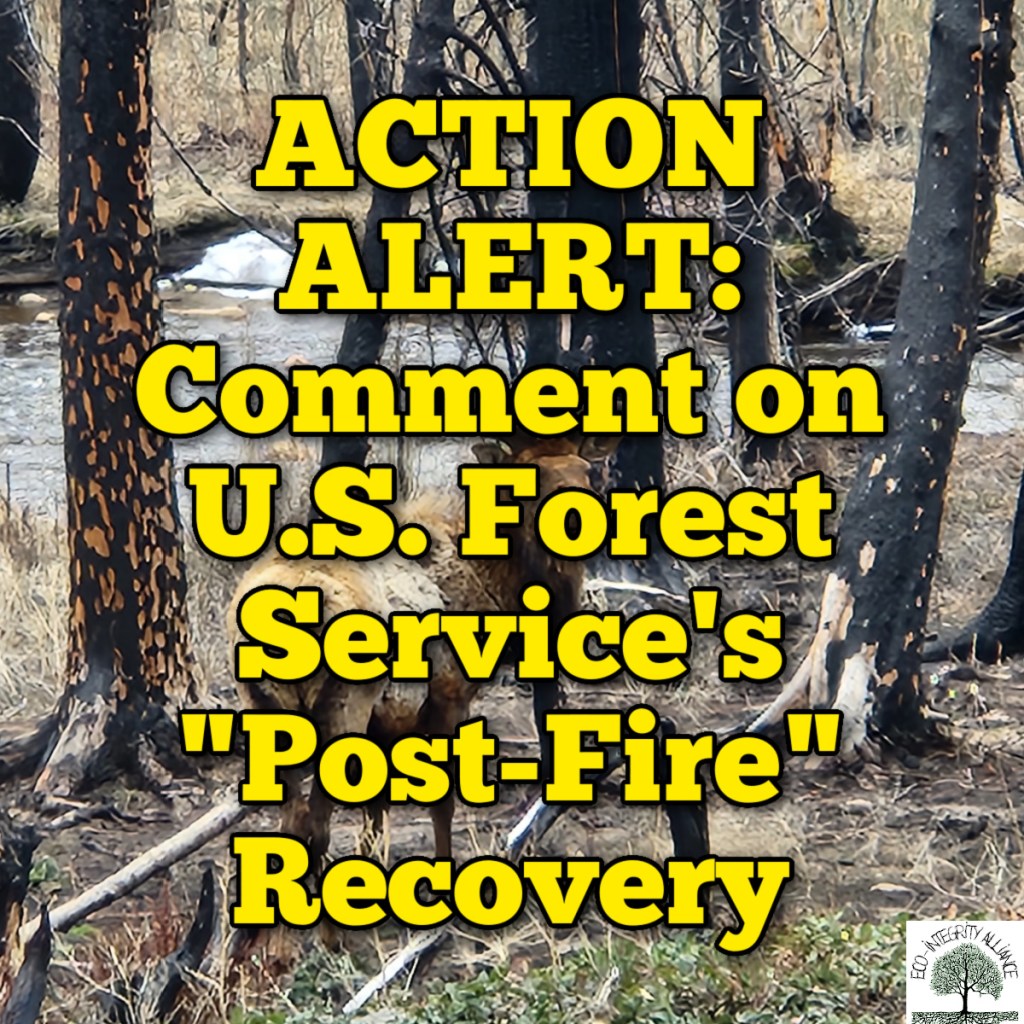
The U.S. Forest Service is proposing a nationwide Environmental Assessment (EA) “to analyze the effects of post-fire recovery actions”—i.e. destructive logging and roadbuilding—in National Forests.
Specifically, the agency wants to log “fire-killed and damaged trees before they lose their economic value” (including clearcutting and old-growth trees) and rebuild permanent roads or build new temporary roads as needed to do so.
The federal effort appears designed to lock in the idea of doing actions—especially “salvaging” fire-damaged trees—on lands affected by fire, potentially in essential wildlife habitat and important forest ecosystems, and to encourage large-scale actions, including those that occur on more than one Ranger District or even National Forest/Grassland. Given potentially low budgets and lack of personnel, the danger is that the agency will use the national EA as an excuse for doing minimal or no NEPA (National Environmental Policy Act) analysis for projects.
Some post-fire actions may be justified, such as: emergency erosion control, legitimate actions to maintain public safety, and responding to early stages of invasive species. However, the scientific literature is clear that burned forests are vital living ecosystems, and that any logging, roadbuilding, and/or use of heavy equipment accelerates soil erosion and slows or even prevents natural tree regeneration.
TALKING POINTS FOR COMMENTS (feel free to use any or all of these):
-Areas that have recently experienced wildfire vary greatly across the National Forest system making a one-size-fits-all analysis impossible. If a nationwide analysis occurs, it should be a more in-depth Environmental Impact Statement (EIS), not just a simplified Environmental Assessment (EA). The public should be allowed to comment on the draft document.
-Post-fire logging and road construction is an ecological disaster, as burned forests—even severely burned—are crucial components of forest ecosystems and necessary habitat for an abundance of wildlife species (some of which require burned forests for survival). Post-fire logging destroys forest ecosystems and wildlife habitat, and the use of heavy equipment disturbs fragile soils recovering from fire. This slows recovery of vegetation, including reforestation.
-If projects are approved, there must be money and qualified personnel available to monitor and evaluate impacts.
Comments are due on Monday, January 26. Please submit them through the Federal eRulemaking Portal: https://www.regulations.gov/document/FS-2025-0034-0001
 Eco-Integrity Alliance