Despite overwhelmingly negative public feedback, Jefferson County Open Space is in the final stages of logging hundreds of acres of Alderfer/Three Sisters Park in Evergreen, Colorado—including fire-resistant old-growth ponderosa pine trees up to 211 years old—under the justification of “wildfire fuels,” ignoring an entire body of peer-reviewed scientific studies disputing claims of such “thinning” protecting communities.
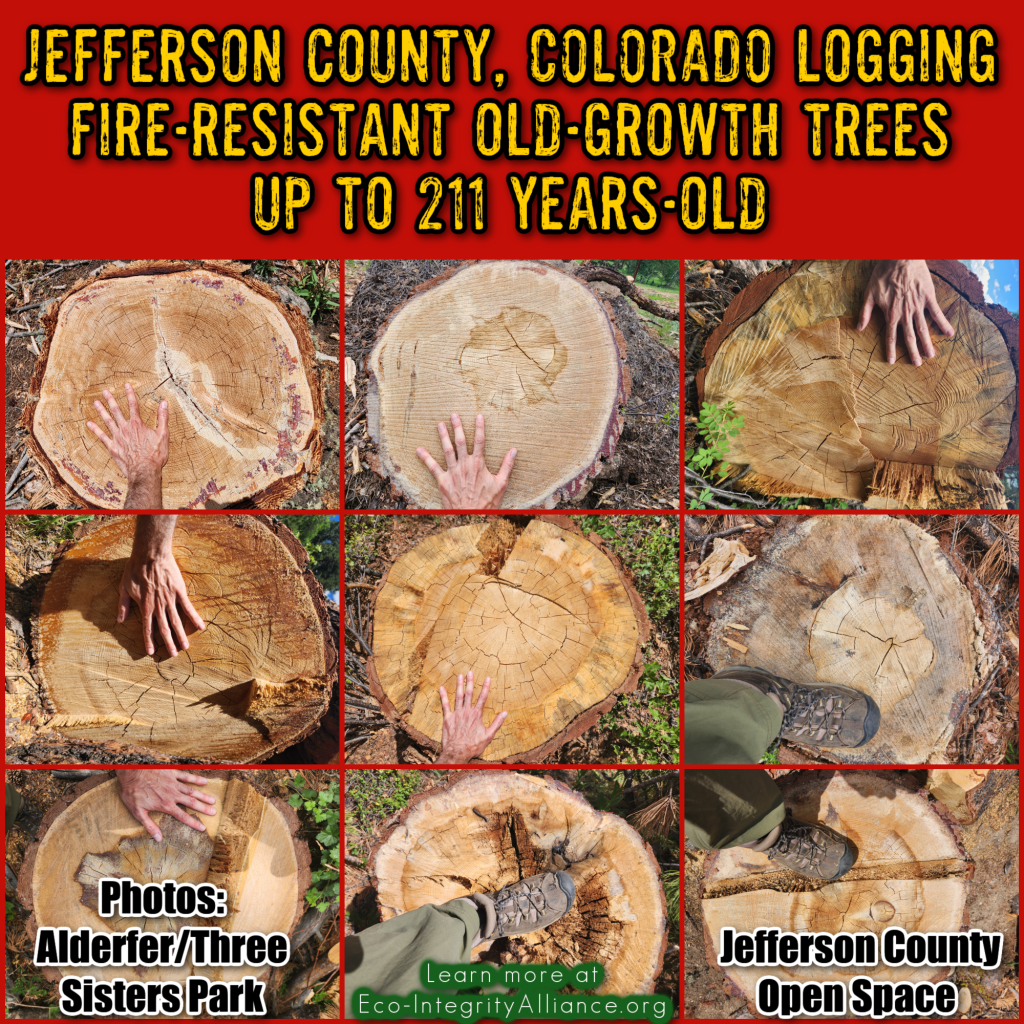
While JeffCo’s Alderfer/Three Sisters Park webpage boasts of “beautiful old stands of ponderosa pine,” many of these trees, including ones over two-hundred years old, have been cut down. The tree removal even contradicts the County’s own “Forest Health” Plan which claims to “promote larger diameter and fire-resistant trees such as ponderosa pine,” while stating that they are “underrepresented and, in most cases, should be favored for retention.”
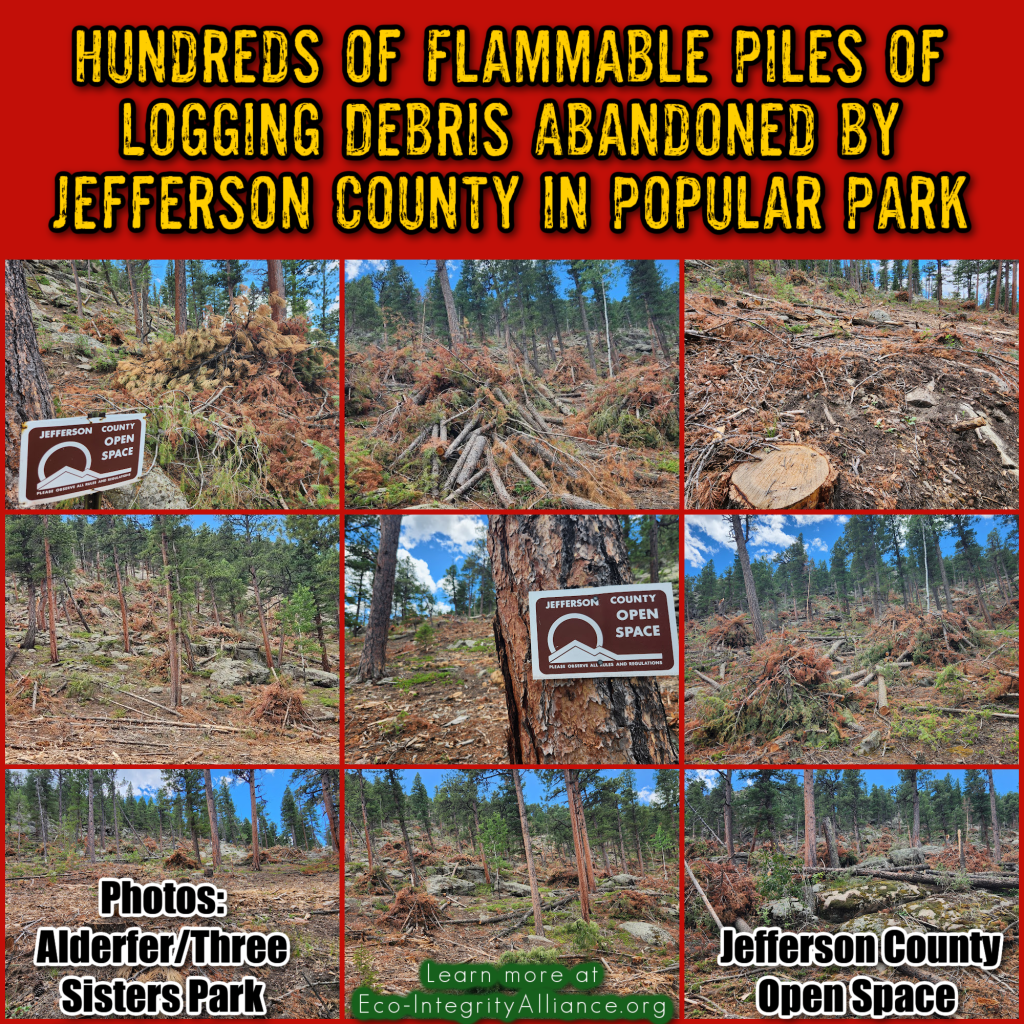
Jefferson County Open Space also left behind hundreds of piles of flammable post-logging debris. Stacks of cut branches with dead needles now litter a landscape where stands of ponderosa pines have been torn apart by recent logging. The aggressive cutting exposes the forest to the drying and heating effects of sunlight and penetration of wind, resulting in an extreme risk of this post-logging kindling starting, sustaining, and spreading wildfire during the current very hot and dry summer weather.
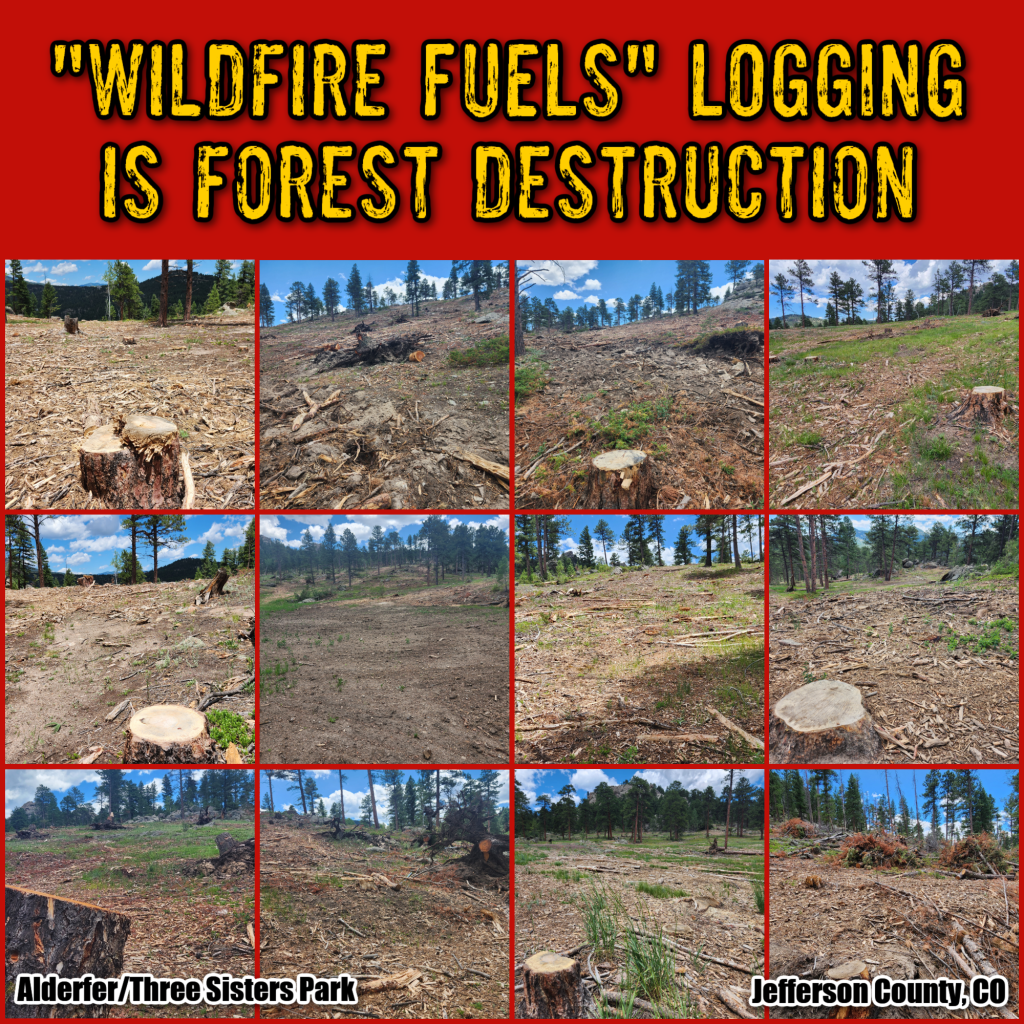
In the space of less than a year, Jefferson County Open Space logged twenty percent of the extremely popular park, mostly adjacent to trails, shocking many locals who have hiked there for years, including some who say they will never return.
Not only has the County degraded hundreds of acres of biodiverse, carbon-storing forests in Alderfer/Three Sisters Park, photos show several dozen more ponderosa pines blown over by winds at the edge of clearcuts due to the sudden lack of protective forest cover. Crews are currently “salvage logging” these “windthrow” trees, while in adjacent unlogged groves hardly any newly fallen trees can be found.

While this controversial “fuel reduction” is proposed for millions of acres of federal, state, county, and municipal public forests across Colorado’s Front Range alone, photographic evidence proves that Jefferson County Open Space is cutting more aggressively than elsewhere in the state due to its logging of mature and old-growth trees.
At a public “town hall” in February 2023, Jefferson County Commissioner Lesley Dahlkemper falsely insisted that the county was not logging older trees despite photographs showing otherwise on a table in front of her. Over a year and a half later, even with Denver Post, Westword, and other media outlets publishing photos of the big stumps and logs, Dahlkemper has still not corrected the record.
“Adapting western North American forests to climate change and wildfires: 10 common questions” by Susan J. Prichard et al. in the peer-reviewed journal Ecological Applications in 2021, is one of hundreds of studies that not only predicted the “windfall” trees but contests the entire notion that “thinning” will reduce the spread of fire—a natural and essential process in forest ecosystems—into communities.
Specifically, the study found that, “mechanical treatments may increase the risk of fire by increasing sunlight exposure to the forest floor, drying surface fuels, promoting understory growth, and increasing wind speeds that leave residual trees vulnerable to wind throw.”
Over the last few years, this unprecedented onslaught of “wildfire fuels” logging has decimated many Jefferson County Parks. In 2022, Flying J Ranch Park’s popular hiking trails were marred by 150 acres of clearcuts.

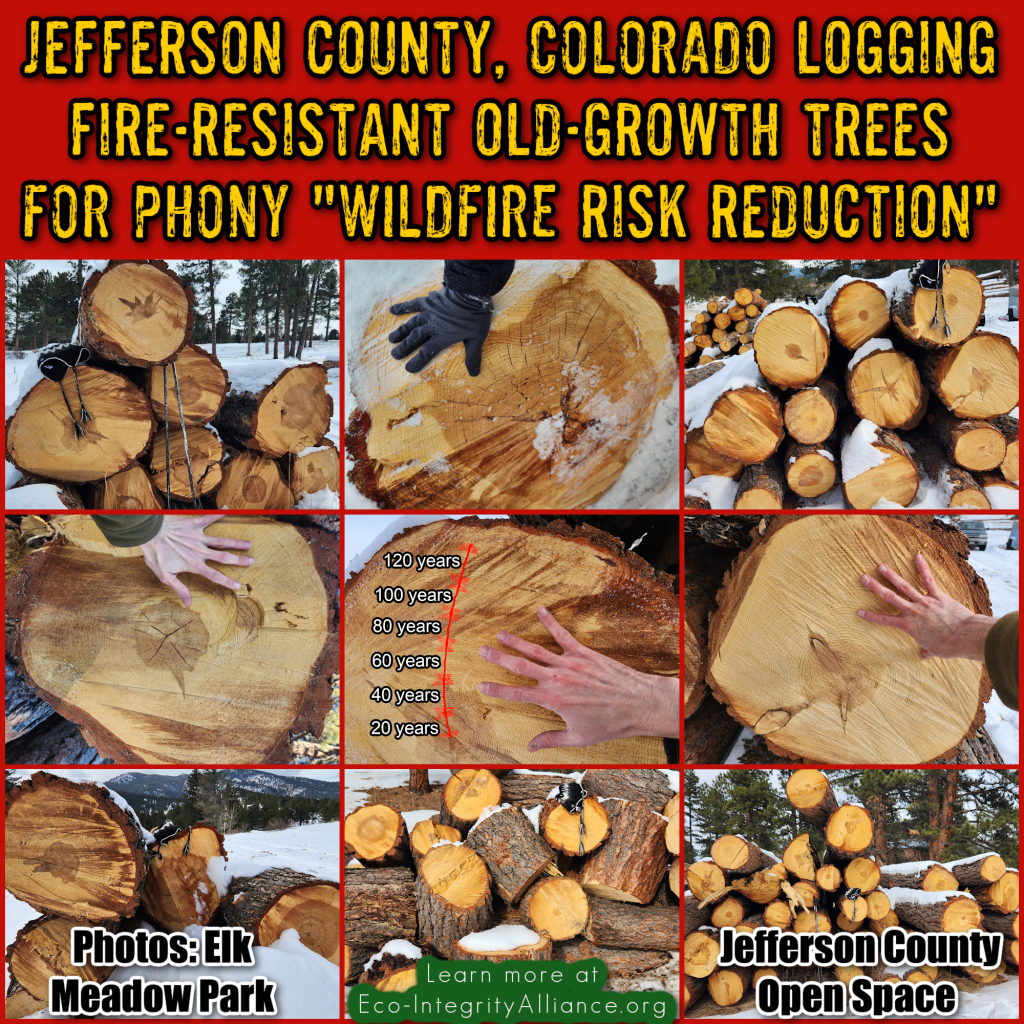
In 2023, JeffCo logged hundreds of mature trees over 100 years old in Elk Meadow Park, with dozens more falling in subsequent months as the direct result of wind penetrating the once-sheltered stands. Starting this week, Jefferson County is closing most Elk Meadow trails for nearly a year to conduct an additional 335 acres of intensive “fuel reduction” logging.
While the County plans to log up to 1,000 acres by 2025, its “Forest Health” Plan warns it may be “feasible” to log up to 25,270 acres of forests—39.5 square miles—across 32 public parks and hiking trails, at taxpayer expense.
JeffCo has thus far given no opportunity for meaningful public engagement or feedback on the logging, while County Commissioners Lesley Dahlkemper, Tracy Kraft-Tharp, and Andy Kerr have refused to respond to a citizen petition signed by close to 700 people asking them to incorporate independent (i.e., non-agency or industry-funded) wildfire science into their decision making.
While the need for and effectiveness of “fuel reduction” logging is widely contested across the scientific literature, the consensus is that hardening homes—“Firewise” measures such as installing non-flammable roofs and maintaining defensible space 15-60 feet around structures—is the only action proven to protect communities from wildfires.
 Eco-Integrity Alliance