Months after receiving photos of sediment being dumped into Longmont’s drinking water supply from “wildfire risk reduction” logging carried out by Boulder County Parks and Open Space, Colorado Department of Public Health and Environment (CDPHE) admitted it had let the accused violator investigate—and exonerate—itself.
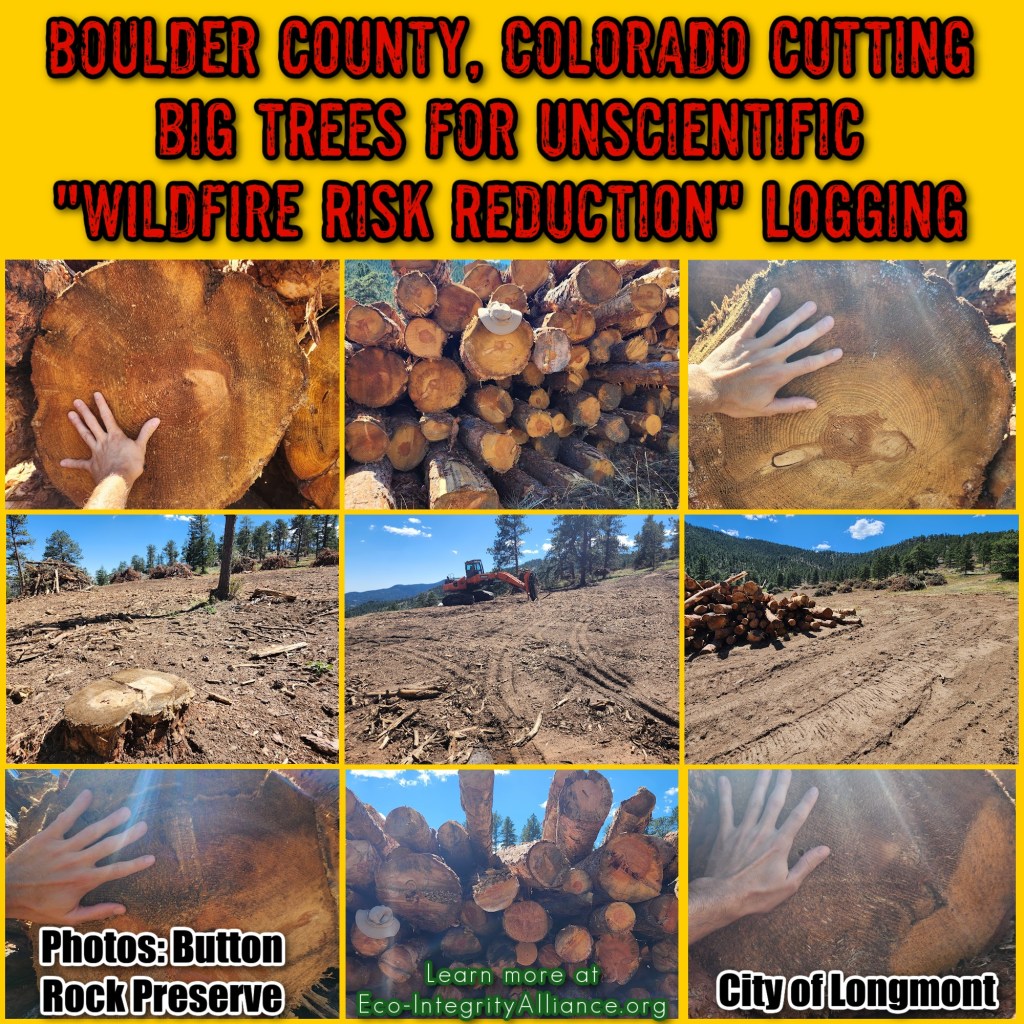
Photos taken this summer show muddy, eroding logging roads from the “Antelope Park Forest Health Project” dumping sediment into a stream flowing directly into Longmont Reservoir, drinking water supply for the city’s 98,885 residents. [1]
A formal complaint was filed by Eco-Integrity Alliance (EIA) on June 7 with CDPHE’s Water Quality Control Division, which asked for GPS coordinates to investigate the reported violation. Yet, after dozens of calls and emails asking for updates over a period of two months, EIA was finally told the matter had been dismissed…by the subject of the complaint overseeing the logging, project manager Scott Golden with Boulder County Parks and Open Space.
The Antelope Project has gouged out miles of new roads above the reservoir to facilitate so-called “wildfire risk reduction” logging over 3,000 acres in Button Rock Preserve west of Lyons in Boulder County, cutting many of the largest, most-fire resistant trees in the forest up to a mile away, including in a Winter Elk Concentration Area closed to hikers from December to March to “protect wildlife.” The taxpayer-subsidized logging is being carried out under the umbrella of the St. Vrain Forest Health Partnership. [2]
Photos show thick layers of sediment coating rocks in the streambed directly below muddy, eroding logging roads. Sediment can also be seen collecting on cement at the intake pipe for the drinking water supply a few hundred yards downstream. Other photos show hundreds of large ponderosa pines up to 2 feet in diameter—the most fire-resistant trees in the forest—cut and stacked for lumber by Markit! Forestry Management.
Ironically, much of the justification for logging the supposedly protected Button Rock Preserve is to “protect the quality of water…as it relates to resiliency in the event of a wildfire.” Instead of the theoretical possibility of erosion from the natural and essential process of wildfire, the logging roads have guaranteed deposits of sediment in the drinking water supply. [3]
Independent, non-agency-funded studies conclude that not only won’t logging stop large wildfires, it can make them burn hotter and spread faster by opening forests to sunlight and wind. [4]
Indeed, the entire premise of logging to create “historical conditions” of parklike forests due to “overgrown” stands and “unusual” high-severity wildfire has been repeatedly debunked by multiple studies in peer-reviewed journals. Contrary to the industry/agency narrative, these studies find that western forests—including in Colorado’s Front Range—prior to fire suppression did grow densely and did experience high-severity wildfire. [5]
“This spring at a public meeting we warned the St. Vrain Forest Health Collaborative of the near-certainty of erosion from gouging out logging roads on steep slopes above our drinking water supply, but they ignored us,” says Josh Schlossberg, Longmont resident and Colorado steering committee member of Eco-Integrity Alliance. “Since the State of Colorado has admitted there is literally no oversight for these projects, we’re calling for an immediate moratorium on all so-called ‘wildfire risk reduction’ logging on public lands until independent scientists and concerned citizens are allowed to meaningfully engage in the decision-making process.”
[1] https://drive.google.com/drive/folders/1IHgMrqWz_uu6PSCua1reoZhukZWn4xBd?usp=sharing
[2] https://nocofireshed.org/fires/antelope-park/
[3] https://www.longmontcolorado.gov/home/showpublisheddocument/17289/636207692217330000
[4] https://www.energyjustice.net/files/biomass/library/Carey-Schumann.pdf
[5] https://www.mdpi.com/2571-6255/6/4/146
 Eco-Integrity Alliance